



The tongue has the power of life and death, and those who love it will eat its fruit. Proverbs 18:21
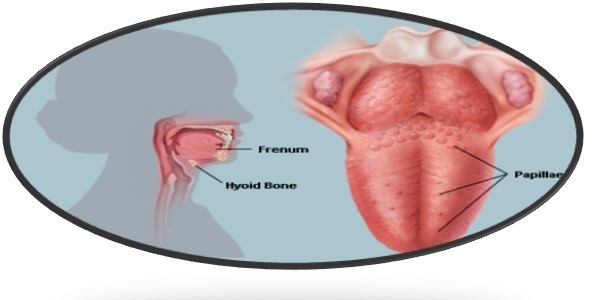
The tongue is a muscular organ in the mouth. The tongue is covered with moist, pink tissue called mucosa. Tiny bumps called papillae give the tongue its rough texture. Thousands of taste buds cover the surfaces of the papillae. Taste buds are collections of nerve-like cells that connect to nerves running into the brain.
The tongue is anchored to the mouth by webs of tough tissue and mucosa. The tether holding down the front of the tongue is called the frenum. In the back of the mouth, the tongue is anchored into the hyoid bone. The tongue is vital for chewing and swallowing food, as well as for speech.
The “tongue” is used throughout Scripture in both literal and metaphorical ways, especially in Psalms, Proverbs and James. The tongue is a “small part of the body” (James 3:5), yet Proverbs 18:21 says it “has the power of life and death.” This holds true whether we’re speaking of spiritual, physical or emotional “life and death.”
We should keep in mind that the word “tongue” is often a reference to the spoken word. This is a special kind of figure of speech called metonymy, in which one word stands in for another, closely related word. A common example of metonymy is seen in this sentence: “The White House issued a statement.” Of course, the White House, as a building, cannot issue statements; however, in this instance, White House refers to the President, who lives there. In the same way, when Proverbs 15:4 states, “A deceitful tongue crushes the spirit”, tongue is a metonymy. Obviously, a literal, fleshly tongue cannot crush the human spirit, but the words the tongue produces can.
Your speech will either help or hurt you (Pro. 10:14 – “The wise store up knowledge, but the mouth of a fool invites ruin”; Pro. 12:14 – “From the fruit of their lips people are filled with good things, and the work of their hands brings them reward”; Pro. 13:2-3 – “2. A man shall eat well by the fruit of his mouth, But the soul of the unfaithful feeds on violence. 3. He who guards his mouth preserves his life, But he who opens wide his lips shall have destruction”; also see Pro. 18:6-7, 23). If you are older, it already has! Many have ruined their lives by not ruling their mouths. Others have been exalted for their kind and wise tongues. Your speech will bring either blessing or cursing on you from both God and men, in both time and eternity. Do you love good speech or bad speech? Your future will be impacted heavily by your choice of words and habit.
A tongue can kill or save others’ lives. A false witness can cause the death of an innocent man, or a comforter can restore a dejected, depressed or miserable man by an uplifting word. A slanderer can kill the reputation of a good man, or a wise counselor can guide a young man through the dangers of youth. A seducing girl or woman can ruin a man’s life, or a godly mother can teach her children the truth. A tongue definitely affects others, but that is not the lesson here.
The tongue also affects speakers. The death and life in the power of the tongue are the effects of your speech on yourself. You learn this by the second clause in our text, which teaches that those loving their use of the tongue will eat either the fruit of death or life. You also know this by the context, for the previous proverb reads, “A man’s belly shall be satisfied with the fruit of his mouth; and with the increase of his lips shall he be filled” (Pr 18:20).
Consider the love of speech, which is a key in this proverb. Even evil men can say good things when it is to their greedy purposes to do so, and good men slip from time to time and say things they should not (Pr 23:6-8; Eccl 10:1). But only good men truly love good speech, and only evil men truly love evil speech. The law of the proverb is based on what kind of speech you love – the speech you commit your heart, mouth, and habits toward.
When you see a man failing in life, he likely did not rule or bridle his tongue. You can see the failure in his marriage(s), with his children, and in his profession. Criticism and harshness cost him affection. Exaggerations and extreme words cost him trust. Complaining and whining cost him influence. Arrogance and disrespect of authority cost him promotions. Too many words cost him listeners. Backbiting and talebearing cost him respect. Foolishness and jesting cost him honor. Unkept promises made him a liar. He is dead!
He committed suicide with his tongue! He ate the fruit of death! He used the power of his tongue to his own destruction. He would not rule his spirit or teach his tongue wisdom (Pr 16:23, Pr 25:28). Therefore, both God and men punished him for his verbal folly. God turned to be his enemy, and men avoided him and cut him out of their friendships and profitable endeavors. He used the power of his tongue to his own destruction and death.
Other men rise like cream to the top, because they rule their speech. They limit words (Pr 10:19; 17:27-28). They use gentleness rather than bluster (Pr 15:1; 25:15). They speak only the certain words of truth (Pr 22:17-21). They never talk against a man not present (Pr 16:28; 26:20-22). They study and think before speaking (Pr 15:28). They are always thankful. They seldom speak up unless asked (Pr 18:13; 29:11; Jas 1:19). Their gracious speech wins the hearts of men and women – they are soon friends with the king (Pr 16:13; 22:11). They are a tree of life to others and to themselves (Pr 10:11; 13:3; 15:4). Their words minister grace to hearers.
When a woman is a failure, she likely did not rule her tongue. Harsh and critical speech, nagging reminders, snotty retorts, or constant suggestions destroyed her husband’s affection – she killed her marriage. Her children cannot wait to get out of the house, because the overbearing and continual criticism is too much to bear. She is odious! She has no friends, because everyone hates an odious woman. She committed marital, domestic, and social suicide with her tongue. She ate the fruit of death. She is dead.
A gracious woman is always honored (Pr 11:16). The rule is simple and absolute – a woman that rules her tongue will have many friends and a glorious reputation. She has the law of kindness in her mouth, and she only speaks when she has something wise and important to say (Pr 31:26). She never speaks to hear herself talk, to offer trivialities, to correct minor details, or to make sure she contributes more than others in a group. She has a meek and quiet spirit – one that hates talking without a noble purpose (I Pet 3:3-4).
Young man, learn sound speech before it is too late. Keep company only with gracious and wise men, who rule their mouths. Reject every man with a foolish and loud mouth. Learn Solomon’s wisdom about teaching your lips (Pr 4:24; 6:12; 8:13; 10:31-32; 15:28; 16:23). You can greatly enhance your future by learning good speech for all occasions.
Young woman, you should learn and practice the same things. If you do not, you will have difficulty finding a man that will ruin his life by marrying you. An odious woman is a terrifying threat to men, and a young man can discover you with his ears. You must despise idle chatter, giggling, foolish talking, opinionated debate, or other odious traits.
Old man, you are already eating the fruit of your mouth. The only hope you have is to confess your sins of speech to God and men, speak only gracious and wise words when asked, and beg God for the wisdom and strength to rule your unruly tongue. Learn Paul’s advice for you to be sober and grave, so cut out jesting and foolish talking (Tit 2:1), Col. 4:6.
Old woman, you have likely scarred your husband’s heart. And your children, while not telling you, rejoice when they can get away from you or end a phone conversation. How many crave your presence and pursue conversation with you? If the number is low, you have a speech problem. Follow the advice given to the old man and trust God for mercy.
Spiritual Implication:
What our tongue produces has eternal implications, for it reveals what is in our heart. Jesus said that “the good man brings good things out of the good stored up in him, and the evil man brings evil things out of the evil stored up in him” (Matthew 12:35). Isaiah places words on par with actions for displaying a sinful heart (Isaiah 59:2-3). “Men will have to give account on the day of Judgment for every careless word they have spoken” (Matthew 12:36). In and of ourselves, we are utterly unable to “tame the tongue” because “it is a restless evil, full of deadly poison” (James 3:8). A tongue under control is a mark of the Spirit’s power. Apart from accepting Jesus’ atonement on the cross, we will be judged according to our words: “For by your words you will be acquitted, and by your words you will be condemned” (Matthew12:37).
Emotional Implication:
Emotions are powerfully affecting, yet they are vulnerable to injury. James describes the tongue as “a fire” (James 3:6) – and who has not been burned by it? Proverbs 15:4 describes a “healing” tongue as “a tree of life.” As much as love is an action, what would romance be without words? Encouragement often comes through spoken words. So does discouragement. “Reckless words pierce like a sword” (Proverbs 12:18). The wound is emotional, and it is deep. What we say can have a profound effect on others.
Physical Implication:
In order to take Proverbs 18:21 literally – that the tongue can cause physical life and death – we do not need to tax our imagination. Words create actions, good and bad. A judge or jury, by simply saying a word, can cause a person to be killed or to live. Words often save lives: a doctor advises surgery, a weatherman issues a tornado warning; a counselor gives hope to a suicidal person. Conversely, words can also kill: murders are often initiated because of arguments or verbalized hatred. In the sense of causing action, then, the tongue does indeed have the power of life and death.
Conclusion:
God made us expressive beings, so we are nearly lost without communication. That is why we have audio recordings and Braille for the blind, sign language for the deaf, and writing for anyone who has something to say from afar. Indeed, speech has enormous implications, especially as a vehicle for sharing the gospel (Romans 10:14). Therefore, we are commanded to control the tongue, to “keep [it] from evil and your lips from speaking lies” (Psalm 34:13). A Christian’s speech should consistently honor the Lord: with the tongue “we praise our Lord and Father, and with it we curse men, who have been made in God’s likeness. Out of the same mouth come praise and cursing. My brother and sisters, this should not be” (James 3:9-10).
Brethren, your words will bring death or life in this world and the next. Jesus said, “But I say unto you, that every idle word that men shall speak, they shall give account thereof in the day of judgment. For by thy words thou shalt be justified, and by thy words thou shalt be condemned” (Matt 12:36-37). Death and life are in your tongue. Choose life! Eph.4:29 says, let no corrupt communication proceed out of your mouth, but that which is good to the use of edifying, that it may minister grace unto the hearers.
Prayer Points
Father, let the Holy Ghost fire possess my tongue in Jesus name.
Father, help me bridle my tongue so that it will not lead me to hell fire
Father, Let my speech be always with grace, seasoned with salt
Father, make me a living example to the world around me in word, and conversation.
Father, cancel every evil words I have spoken concerning my life and neighbors.
Dcn. Mike Ben
Many of us are waiting on God to move in our lives, but God is waiting for us to bridle our tongues (James 1:26) “if any man among you seem to be religious, and bridles not his tongue, but deceives his own heart, this man’s religion is vain”. And
use their tongue to shape their lives (Proverbs 15:2,4) “the tongue of the wise uses knowledge aright, but the mouth of fools pours our foolishness. A wholesome tongue is a tree of life, but perverseness therein is a breach in the spirit”. People have to stop blaming God for where they are and exercise using their tongues to speak life into their circumstances. I have resolved to bridled my tongue.
Mike Ben
The article appear long to be read in hurry. It very thoughtful and impactful. How i wish our generation and younger ones could devote our time to read article like this. God bless you sir.